

If you have spent any time reading about the global tea industry over the past decade, you have probably noticed a quiet anxiety running through it. Yields dropping in Assam. Unseasonal rains disrupting harvests in Sri Lanka. Kenyan tea farmers watching the rains come later every year, or not at all. The conversation around climate and tea has shifted, slowly and then all at once, from a future concern to a present reality.
Rwanda is not immune to this conversation. But it is having a different version of it.
In the mountains of northwestern and southwestern Rwanda, where Rwanda Mountain Tea tends its eight gardens across 9,646 hectares, the relationship between climate and tea is more complicated than simple vulnerability. The altitude, the volcanic soil, the particular rhythm of rain that the Rwandan highlands have always known, these things create a form of natural resilience that most tea-growing regions simply do not have. And on top of that natural advantage, RMT has been building something intentional: a way of farming and managing land that is designed to last not just for this season, but for the next generation.
This is that story.
What Climate Change Is Doing to Tea, Globally
Tea is one of the most climate-sensitive crops on earth. The plant, Camellia sinensis, evolved over millennia in specific conditions, defined temperature ranges, reliable rainfall, particular humidity levels. Shift those conditions too quickly, and the plant does not simply adapt. It struggles. Yields fall, leaf quality drops, and the complex chemistry that gives fine teas their character begins to break down.
Globally, tea-producing countries are seeing all of this at once. Rising temperatures are pushing optimal growing zones up mountains that cannot keep going forever. Rainfall is becoming less predictable. Pests and diseases that cold winters once kept in check are spreading. The World Tea Atlas estimates that by 2050, the land suitable for tea production in many major growing regions could shrink significantly if current warming trends continue.
Rwanda sits in a different position from most. And it is worth understanding why.
Why Altitude Is Rwanda’s First Line of Defence
The tea gardens managed by Rwanda Mountain Tea sit between 2,300 and 2,700 metres above sea level. That is not incidental to the quality of the tea, it is the foundation of it, as we have written about in detail in The Secret Behind Rwanda’s Award-Winning Teas: Altitude, Climate and Expertise. But that same altitude is also a significant buffer against climate change.
Here is why: as global temperatures rise, lowland tea-growing regions are pushed beyond their optimal range quite quickly. A rise of 1.5 to 2 degrees Celsius can fundamentally change the growing conditions at sea level or at 500 metres. At 2,500 metres, the same rise in temperature means your conditions are moving toward what lower elevations had before. In other words, high-altitude gardens have something like a climate buffer, they can absorb a certain degree of warming before their conditions become unfavourable.
This is not a reason for complacency. But it is a meaningful structural advantage that Rwanda holds over most of its competitors in the global tea market, and it is one reason why RMT’s gardens are positioned to remain productive and high-quality long after lower-altitude competitors have had to adapt or struggle.
The Soil Beneath the Leaf
Beyond altitude, there is the question of the ground itself. Rwanda’s volcanic soils are deep, mineral-rich, and naturally well-drained. They hold moisture through dry spells and release it steadily to plant roots. They are buffered against extreme pH swings. And they are, in the right hands, extraordinarily fertile.
Volcanic soils also tend to recover well from stress. When rainfall is lower than usual in a given season, a well-managed volcanic soil continues to support root systems that less mineral-rich land cannot. When heavy rains come and they are coming more intensely in parts of Central Africa good drainage prevents the waterlogging that drowns root systems and invites fungal disease.
RMT’s gardens do not take this natural advantage for granted. Soil health is actively managed through organic practices at several sites, most notably at the Rutsiro organic tea garden, which is certified under multiple organic standards and serves as a model for how tea can be grown without synthetic inputs. When you build fertility naturally : through composting, cover crops, careful pruning, you are also building the kind of soil resilience that synthetic fertiliser cannot replicate.
What Organic Farming Has to Do With Climate Resilience
This is a connection that does not always get made, but it is an important one.
Organically managed soils hold more carbon. This matters for climate change on two levels. First, carbon-rich soils are more biologically active, which means they are better at moving water, resisting compaction, and supporting the deep root growth that tea plants need during dry periods. Second, they act as a small but real carbon sink, storing atmospheric carbon rather than releasing it. At a time when agriculture is under pressure to reduce its contribution to greenhouse gas emissions, organic tea farming is genuinely part of the solution rather than part of the problem.
The Rutsiro garden has been pursuing organic certification not as a marketing exercise, but as a farming philosophy. It produces organic certified black CTC tea and organic certified orthodox black and green teas, the result of years of discipline around soil management, pest control without chemicals, and the kind of patient stewardship that short-term agricultural models rarely permit. It sits at an elevation of up to 2,804 metres, the highest plantation in the RMT network, which makes it a particularly clear example of how altitude and organic practice reinforce each other as climate defences.
Water: The Most Urgent Question
Of all the inputs that climate change threatens to disrupt, water is the most urgent. Tea is a thirsty crop. Rwanda’s gardens currently benefit from reliable rainfall patterns linked to the country’s equatorial position and its two rainy seasons. But rainfall variability is increasing across East Africa, and even Rwanda is beginning to experience the early signals: more intense rain events separated by longer dry spells, seasonal shifts that do not always align with what the calendar used to predict.
RMT’s response to this is partly structural and partly cultural. On the structural side, the gardens are increasingly managed with water retention in mind. Ground cover is maintained between tea rows to reduce evaporation. Shade trees, a traditional feature of many Rwandan tea landscapes, are preserved where possible, both to reduce moisture loss and to provide microclimate stability. Factory operations have invested in more efficient water use, reducing waste in the processing chain.
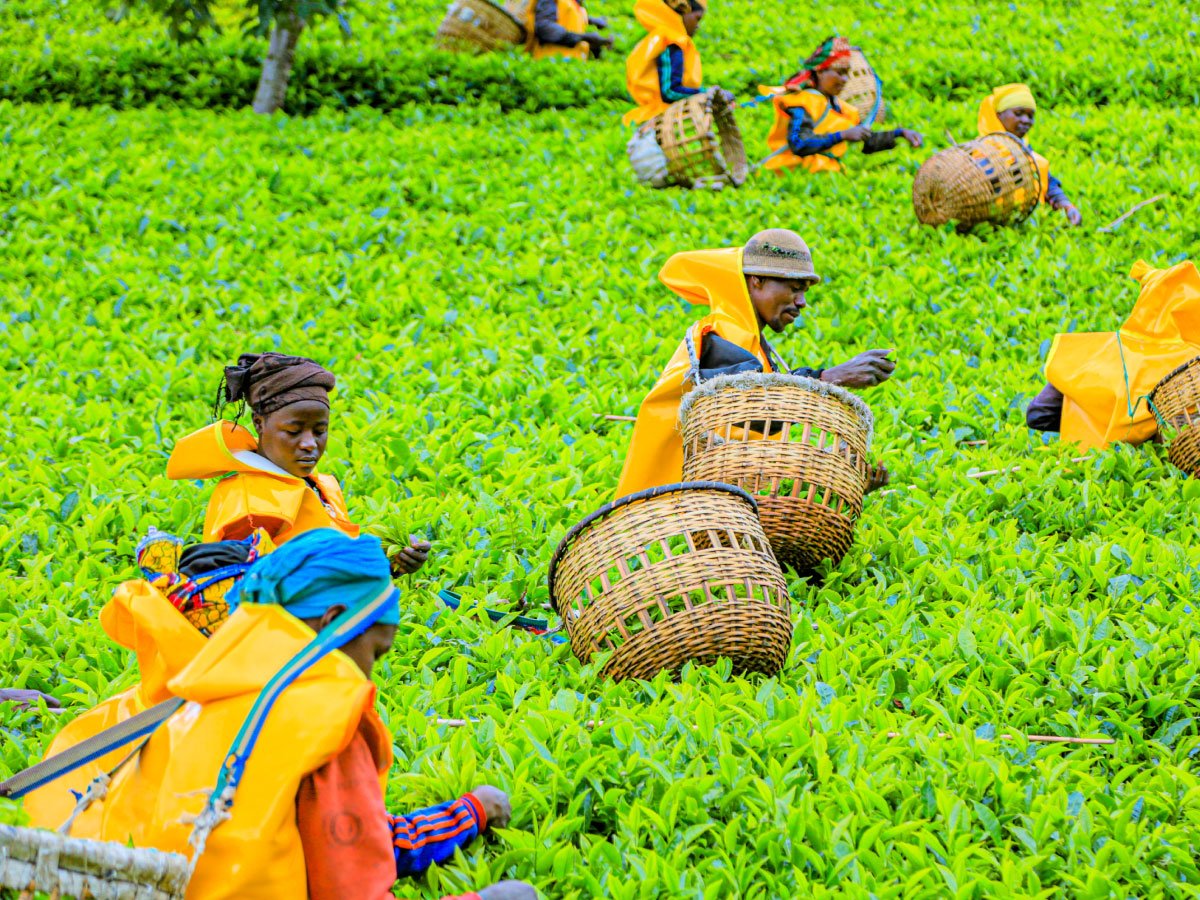
On the cultural side, the farmers and workers who tend these gardens are some of the most important people in this story. Many of the women who work as tea pluckers across RMT’s gardens have been doing this work for years, sometimes decades. Their accumulated knowledge of the land : how the soil behaves in different seasons, where the drainage problems appear, which rows show stress first, is a form of climate intelligence that no satellite or soil sensor can replicate. The investment RMT makes in its workforce, including through its well-documented commitment to empowering female workers, is also an investment in keeping that knowledge on the land rather than losing it to turnover.
Certifications as Climate Accountability
RMT’s suite of certifications ISO 22000:2018, Rainforest Alliance, ECOCERT, HACCP, are not just quality assurances. Each of them carries embedded expectations around environmental stewardship that shape how the gardens are managed year to year.
The Rainforest Alliance certification is particularly relevant here. It requires that certified farms maintain or improve biodiversity, manage water responsibly, protect natural ecosystems adjacent to agricultural land, and continuously improve their environmental performance. These are not abstract requirements, they translate into specific practices on the ground, audited regularly, that make the gardens measurably more resilient to climate stress.
When you buy a tea bearing an RMT Garden Mark, you are not just buying provenance. You are buying into a system of accountability that reaches back to the soil.
The Gardens Themselves as Living Ecosystems
One thing that distinguishes a well-managed high-altitude tea garden from an industrial monoculture is the degree to which it functions as an ecosystem rather than just a crop field. RMT’s gardens include forest buffers, stream corridors, shade trees, and a diversity of ground-level plants that support soil biology and harbour the natural predators that keep pest populations in check.
This ecological complexity is not just aesthetically pleasing, it is a form of climate insurance. Diverse systems are more stable under stress. When one element is disrupted, others compensate. The volcanic landscapes around Kitabi, Rubaya, Nyabihu, Gatare, Gisakura, Mata, and Nshili Kivu are not just beautiful backdrops to the tea harvest, they are active participants in the garden’s resilience.
If you have ever considered visiting these landscapes in person, the Visit Gardens page offers a way to see this firsthand. The relationship between the mountains and the tea growing on them is something that photographs approximate but do not fully capture.
What the Future Looks Like
Nobody honest about climate science will tell you that altitude, good soil, and organic farming make a region completely immune to what is coming. The projections for East Africa include scenarios that challenge even the most resilient farming systems. RMT is not operating under the illusion that the natural advantages it holds today will be enough on their own indefinitely.
What it is doing is building adaptive capacity, the ability to respond to change without collapsing. That means maintaining the soil health and biodiversity that allow for flexibility. It means investing in the human knowledge and institutional relationships that make adaptation possible. It means choosing certifications and practices that create accountability over time rather than just in the moment. And it means being transparent about these challenges rather than pretending they do not exist.
As we explored in From Mountain to Cup: The Journey of Rwanda’s Premium Tea, the excellence of what goes into your cup is the result of a complete system working well from the way the soil is tended, to the two leaves and a bud that are carefully selected by hand, to the processing that preserves what the mountain gave the leaf. Climate resilience is simply the condition that allows that system to keep working.
Rwanda’s mountain gardens are not built to be permanent in the way that stone is permanent. They are built to adapt, thoughtfully, continuously, and with the kind of long-term view that the best stewardship of land has always required.
That, in the end, is what it means to be built to last.
Taste What Was Worth Protecting
If this story has made you curious about what these gardens produce, you can explore the full range in our online retail shop, including teas from the Rutsiro organic garden and the highland estates of Kitabi, Rubaya, and Nyabihu. For businesses, importers, and distributors interested in sourcing directly from these gardens, our commercial and wholesale options are the right place to start.
The mountains are still there. The tea is still growing. And the work to keep it that way is ongoing.


