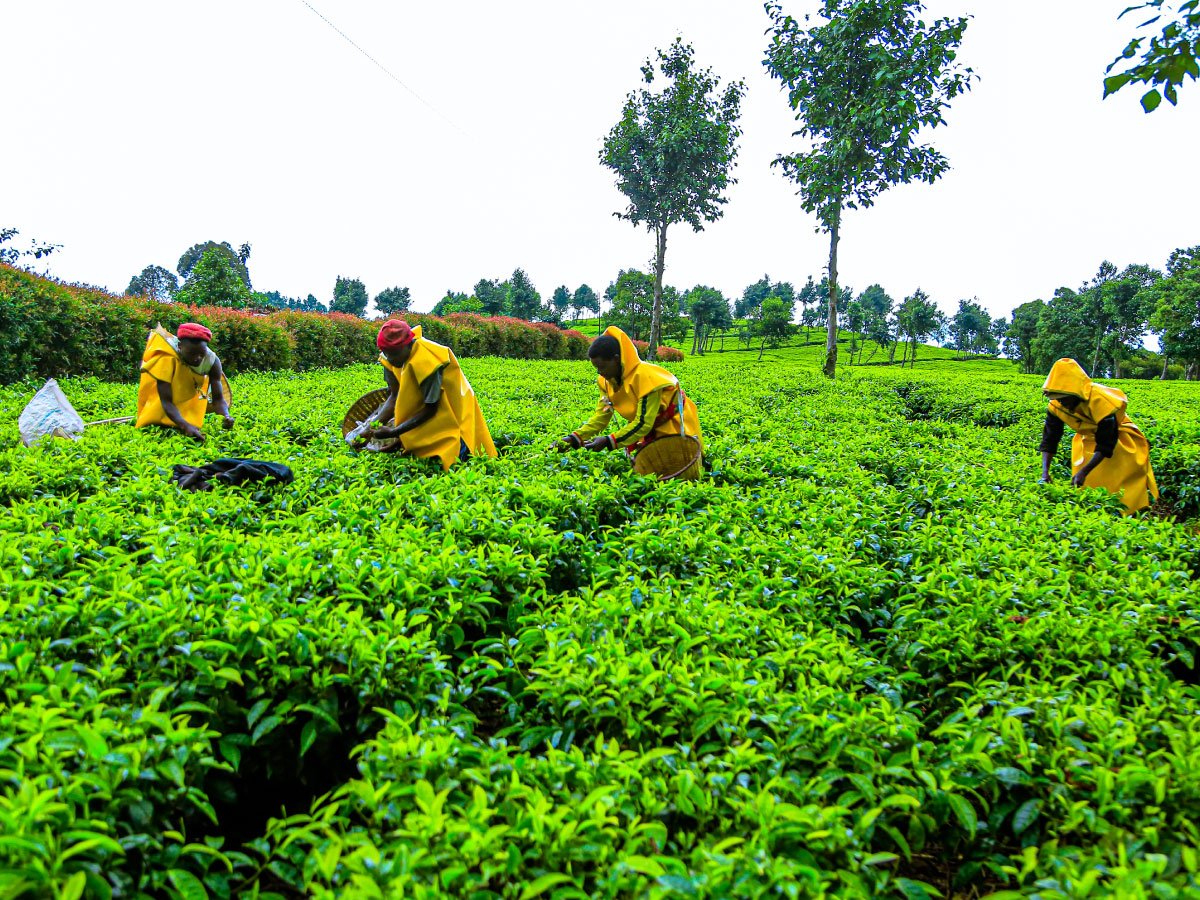
Introduction: Where Tea and Forest Meet
There are tea gardens, and then there is Gisakura.
Nestled in the Bushekeri Sector of Nyamasheke District in Rwanda’s Western Province, the Gisakura Tea Garden is one of the most distinctive estates in all of East Africa. It does not simply produce tea — it produces tea at the edge of one of Africa’s oldest rainforests, surrounded by colobus monkeys, dense canopies, and some of the most breathtaking landscape on the continent.
If you have ever asked yourself what makes a cup of Rwandan tea different from anything else in the world, the answer starts here — in the soil, the altitude, the rain, and the people of Gisakura.
A Garden Unlike Any Other: The Gisakura Setting
Gisakura Tea Company (GTC) is a subsidiary of Rwanda Mountain Tea (RMT) Group, a privately owned company committed to producing the highest-quality teas in Rwanda. The Gisakura estate borders Nyungwe National Park, one of Africa’s largest and oldest montane rainforests — a UNESCO World Heritage Site candidate and home to more than 13 primate species, including the striking black-and-white Colobus monkey.
This proximity to Nyungwe is not just a scenic bonus. It is a competitive advantage.
The forest creates a unique microclimate: consistent humidity, natural shade, and rich biodiversity that contribute to the complexity of the tea grown here. When you drink a Gisakura cup, you are tasting an ecosystem.
Key figures at a glance:
- Elevation at factory: 1,950 metres above sea level
- Highest plantation altitude: 1,900 metres
- Plantation size: 1,596 hectares (36% industrial bloc, 64% outgrower smallholders)
- Average annual rainfall: 2,054 mm
- Average made tea production: 2.67 million kg per year
- People employed: 3,209
These numbers tell a story of scale and consistency — but they do not capture the human dimension that makes Gisakura truly special.
The Journey Begins: From Bud to Pluck
Every cup of Gisakura tea begins with the “two leaves and a bud” — the universal standard for quality hand-plucking. Skilled pickers move along the rows of Camellia sinensis bushes, selecting only the youngest, most tender growth at the tips of each branch.
At an elevation of nearly 1,950 metres, the plants grow more slowly than at lower altitudes. Slower growth means denser cell structures, more concentrated flavour compounds, and higher levels of antioxidants. This is the essence of what the global specialty tea community calls high-altitude advantage — and it is precisely what Rwanda’s National Agricultural Export Development Board (NAEB) identifies as one of Rwanda’s primary competitive strengths in global markets.
The cool nights and warm days at this elevation also trigger the natural formation of thearubigins and theaflavins, the compounds responsible for the deep amber colour and bright, brisk character that Gisakura teas are known for on the international market.
Inside the Factory: Where Craft Meets Process
Once the freshly plucked leaves arrive at the factory, the transformation begins. At Gisakura, the processing follows the orthodox CTC method (Cut, Tear, Curl) — the dominant approach in Rwanda’s tea industry — designed to produce a consistent, full-bodied black tea ideal for both blending and single-origin drinking.
The production stages move swiftly:
1. Withering — Fresh leaves lose moisture over several hours, becoming pliable enough to process without breaking.
2. CTC rolling — The leaves pass through a series of cylindrical rollers that cut, tear, and curl them into small, uniform granules. This unlocks the cell sap and accelerates oxidation.
3. Oxidation (fermentation) — The tea is spread across trays in a cool, humid environment. This is where the green leaf turns copper-brown and develops its characteristic flavour profile. At Gisakura’s altitude, oxidation runs at a pace that results in exceptional brightness in the cup.
4. Drying — The oxidised leaves pass through a hot-air dryer, locking in flavour and reducing moisture to the level required for shelf stability.
5. Sorting and grading — The made tea is passed through a series of vibrating screens that separate it into grades. The main grades produced at Gisakura include BP (Broken Pekoe), PF (Pekoe Fannings), and Dust — each suited for different market segments and brewing applications. To understand what these grades mean for your cup, read our guide: Understanding Tea Grading Systems: What BP, PF, and FBOP Mean for Your Cup.
Certifications: Quality You Can Trust
Gisakura Tea Company holds a suite of internationally recognised certifications, reflecting RMT Group’s commitment to quality, food safety, and environmental responsibility:
- ISO certification — international standard for quality management systems
- Rainforest Alliance certification — guaranteeing sustainable farming practices that protect biodiversity and worker welfare
- HACCP certification — food safety standard ensuring rigorous hazard control at every stage of production
- Eco certification — recognising environmental stewardship across the estate
These certifications are not simply badges. They are the reason Gisakura teas are trusted by importers and buyers across 48 countries, from Pakistan and the United Kingdom to Egypt and the Gulf states.
You can see the full list of RMT Group’s awards and certifications on the awards page.
The People Behind the Cup
Gisakura employs 3,209 people — making it one of the most significant employers in the Nyamasheke District. Of those, a substantial proportion are women working as tea pluckers, factory operators, and community field school trainers.
RMT Group’s vision at Gisakura goes beyond production targets. The estate’s social mission is to build what GTC calls a sustainable tea industry that supports people, communities, and the environment — ensuring tea is enjoyed for generations to come.
This means fair wages, access to healthcare, and active training programmes for smallholder outgrower farmers who supply 64% of the estate’s green leaf. It means that the community around the garden is not just a labour pool — it is a stakeholder in the quality and continuity of what Gisakura produces.
For a deeper look at how RMT empowers women across its gardens, read: Women in Tea: How RMT Empowers Female Workers Across Rwanda.
Gisakura in the Context of Rwanda’s Tea Industry
Gisakura is one of eight gardens operated under the RMT Group umbrella. The others — Gatare, Kitabi, Rubaya, Nyabihu, Nshili-Kivu, Mata, and Rutsiro Organic — each produce teas with distinct characteristics shaped by their altitude, soil, and microclimate.
Together, they position RMT Group as Rwanda’s most diverse and geographically distributed tea producer — a key advantage as Rwanda scales its tea exports toward the national target of USD 175 million by 2029, as set by the NAEB’s national tea strategy, developed in partnership with FAO and the Gates Foundation.
Gisakura’s proximity to Nyungwe also places it at the intersection of Rwanda’s two fastest-growing economic pillars: premium agriculture and eco-tourism. Visitors to Nyungwe National Park — one of the Rwanda Development Board’s flagship destinations — now regularly include a stop at Gisakura as part of an authentic Rwandan highland experience.
The Health Story in Every Sip
Gisakura’s high-altitude black tea is not just exceptional in flavour — it is exceptional for health. Rwanda’s teas grow between 1,500 and 2,500 metres above sea level, a range that produces some of the highest antioxidant concentrations of any tea-growing region in the world.
A cup of Gisakura black tea delivers:
- Theaflavins and thearubigins — powerful antioxidants linked to cardiovascular health
- L-theanine — an amino acid that promotes calm alertness without the jittery edge of coffee
- Natural fluoride — beneficial for dental health in moderate consumption
- Polyphenols — associated with anti-inflammatory effects and immune support
For a full deep-dive into the science behind Rwandan tea’s health profile, read our article: Health Benefits of Rwandan Mountain Tea.
Visit Gisakura: An Experience You Will Not Forget
The best way to understand Gisakura is to stand in the middle of it.
RMT Group offers guided garden tours at Gisakura that take visitors through every stage of the leaf-to-cup journey — from walking the plantation rows and trying your hand at plucking, to observing the factory process and sitting down to a curated tea tasting in the heart of the estate.
The Gisakura experience includes:
- Tea plantation tour with panoramic views of Nyungwe
- Hands-on tea plucking experience
- Guided factory tour
- Tea production process walkthrough
- Professional tea tasting and perfect-cup demonstration
- Picnic tea time on the plantation
- Pack-your-own bag to take home
There is no comparable experience in Rwanda. Possibly on the continent.
To book your visit, head to the gardens tour page and select Gisakura as your destination. Tours run by appointment and are available for both individual travellers and corporate groups.
Order Gisakura Tea in Bulk
For importers, blenders, and wholesale buyers, the Gisakura mark represents a consistent, certified, high-altitude Rwandan black tea with a loyal buyer base at the Mombasa Tea Auction — the world’s largest black tea exchange.
Whether you are sourcing BP1, PF, or Dust grades, our sales team is ready to discuss specifications, volumes, and shipping. Visit the bulk tea page or contact us directly to request a sample and the full Gisakura mark profile.
Conclusion: A Garden That Gives Back
Gisakura is what happens when the right altitude, the right rainfall, the right forest, and the right people come together over decades of dedication. It is a garden that gives back — to the land through sustainable practices, to the community through employment and training, and to the world through tea of extraordinary quality.
Every cup of Gisakura tea carries that story.
If you are curious about what else RMT Group is doing across Rwanda’s highlands, explore our full range of garden marks, browse our retail shop, or get in touch through our contact page.